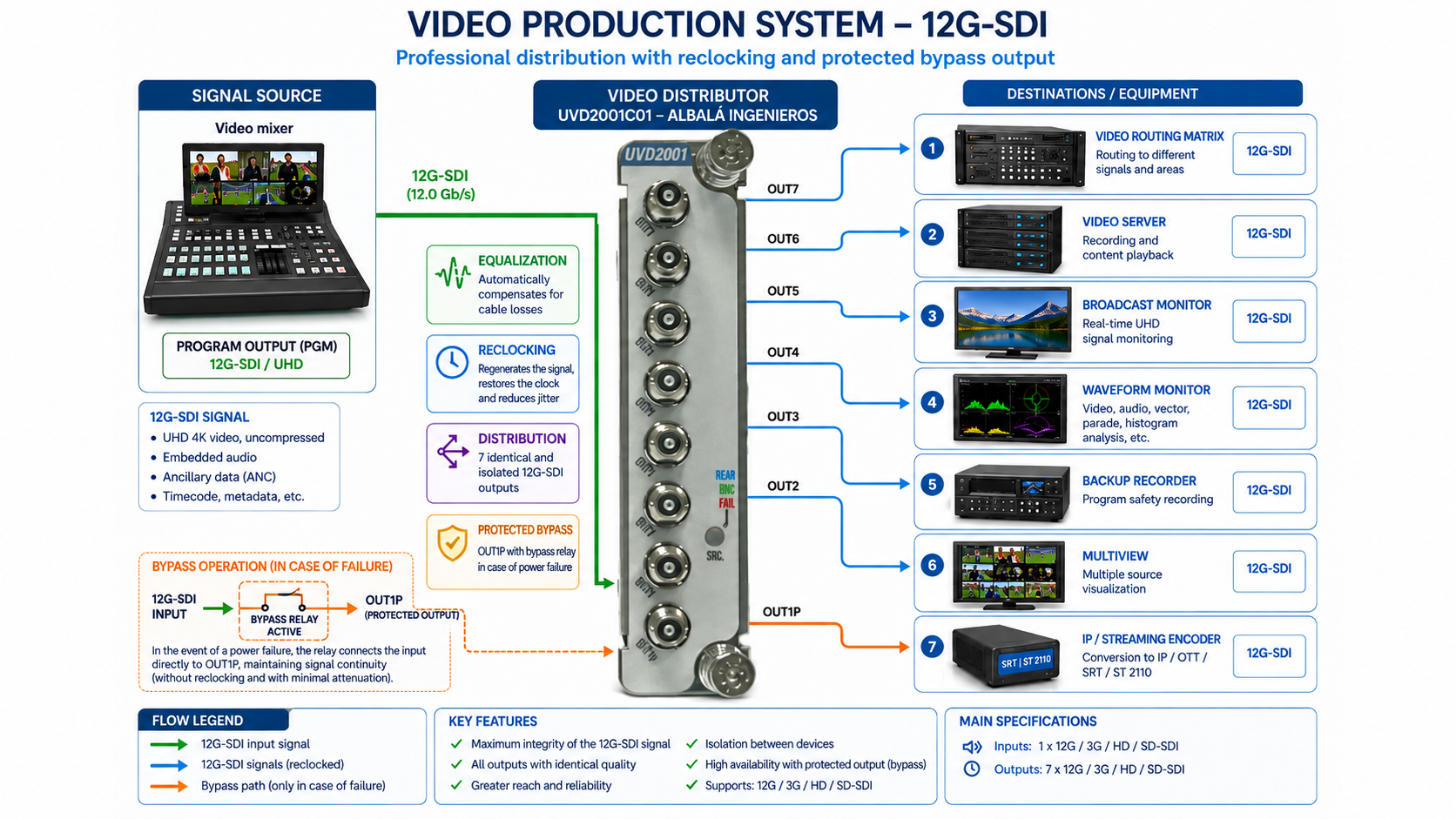
12G-SDI signal distribution is currently the professional solution for transporting uncompressed UHD/4K video over a single coaxial cable, at a data rate of 11.88 Gb/s.
In an advanced Broadcast audiovisual engineering environment, the infrastructure must ensure that all distributed signals retain exactly the same quality as the original signal, without degradation, regardless of the number of connected devices.
When an SDI signal passes through equipment such as routers, distribution amplifiers and, in particular, long cable runs, impairments may occur, including:
• Electrical signal level attenuation.
• Increased jitter.
• Distortion of digital signal edges.
• Accumulation of bit errors in the transmitted digital information.
To prevent these impairments from accumulating, any equipment handling these high-speed digital signals must incorporate two functions: automatic equalization and data regeneration, or reclocking.
Automatic equalization compensates for the frequency-dependent attenuation of coaxial cables, restoring the original waveform of the transmitted digital signal.
Data regeneration, or reclocking, completely reconstructs the digital signal using an internal clock that replicates the original clock used to transmit the data. This regenerated clock is obtained by using the received SDI signal itself as the reference for a PLL (phase-locked loop).
When correctly implemented, these digital-signal equalization and regeneration mechanisms virtually eliminate all the impairments mentioned above. The equalization and regeneration process can therefore be repeated as many times as necessary without introducing errors into the digital transmission.
As a result:
• all outputs deliver a signal identical to the original;
• the maximum transmission distance is considerably increased;
• interoperability between equipment from different manufacturers is ensured;
• the risk of reception errors in very high-speed 12G links is reduced.
In a Broadcast distribution system, reclocking is not merely a quality enhancement; it is a requirement for ensuring system reliability.
In critical installations, it is common for one of the distribution paths to be equipped with a bypass relay.
Its purpose is to ensure signal continuity even when the distribution amplifier:
• loses power,
• fails,
• restarts,
• or is taken out of service.
Under normal operating conditions, the signal passes through the unit's electronics.
If power is lost, the relay automatically switches to establish a direct physical connection between the input and the protected output.
The benefits are significant:
• service continuity during a failure;
• reduced downtime;
• increased overall system availability and reliability.
In Broadcast systems, where a single interruption may result in loss of transmission or disruption of a technical production, this type of protection is a characteristic feature of professional high-availability equipment.
The combination of 12G-SDI signal distribution and an output protected by a bypass relay provides an infrastructure designed for professional Broadcast applications, delivering maximum signal quality, timing stability and operational continuity even in the event of a power failure or equipment fault. These features are particularly relevant in audiovisual engineering systems, professional production environments, and signal contribution and distribution systems where reliability is an essential requirement.
The UVD2001C01 module is a distribution amplifier for 12G/3G/HD/SD-SDI digital video signals, featuring automatic equalization and data-clock regeneration (reclocking). It provides one input and seven outputs, one of which is protected by a bypass relay.
The module can route the SDI signal received at the connector labelled INPUT to the chassis backplane, making it available to the module installed immediately to its right.
The distribution amplifier can automatically detect and regenerate any 12G/3G/HD/SD-SDI digital video format.
The UVD2001C01 does not modify the content of the frame being distributed.
Signal input and outputs use high-density BNC connectors (HD-BNC).
From a Broadcast engineering perspective, the UVD2001C01 is more than a simple signal splitter. It acts as an SDI signal regenerator at the physical layer, providing seven regenerated copies that are bit-for-bit identical to the input signal. Automatic equalization and reclocking ensure signal integrity even over very high-speed 12G-SDI links, while the bypass-protected output ensures service continuity in the event of a power failure or module fault. This combination of signal quality and high availability makes it particularly suitable for production facilities, broadcast continuity applications and professional television environments.
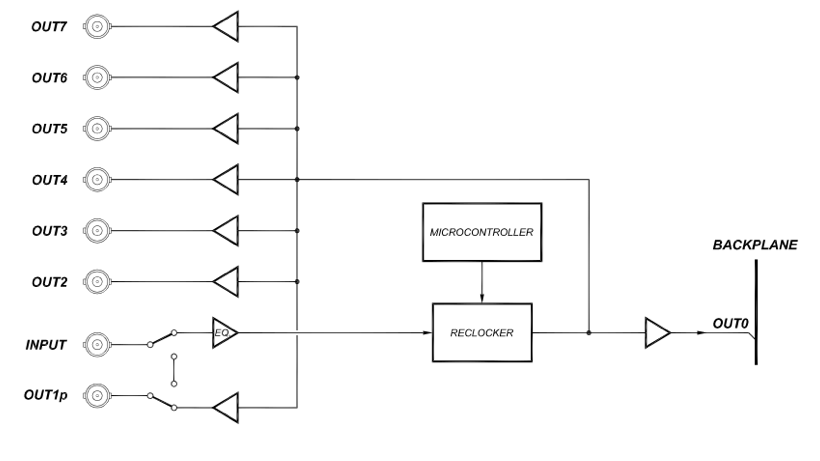
From the block-diagram perspective, the UVD2001C01 implements a sequential processing chain in which each block performs a specific function: the equalizer compensates for cable losses; the detector identifies the presence of an input signal and the received standard; the clock-recovery circuit extracts a stable timing reference; the reclocker completely regenerates the SDI signal; and the distribution amplifier generates seven electrically identical copies. Finally, one output incorporates a bypass relay that ensures transmission continuity in the event of a power failure. This architecture makes the UVD2001C01 a high-performance distribution amplifier designed to maintain maximum signal integrity and high availability in professional Broadcast environments.
The module block diagram is shown below:
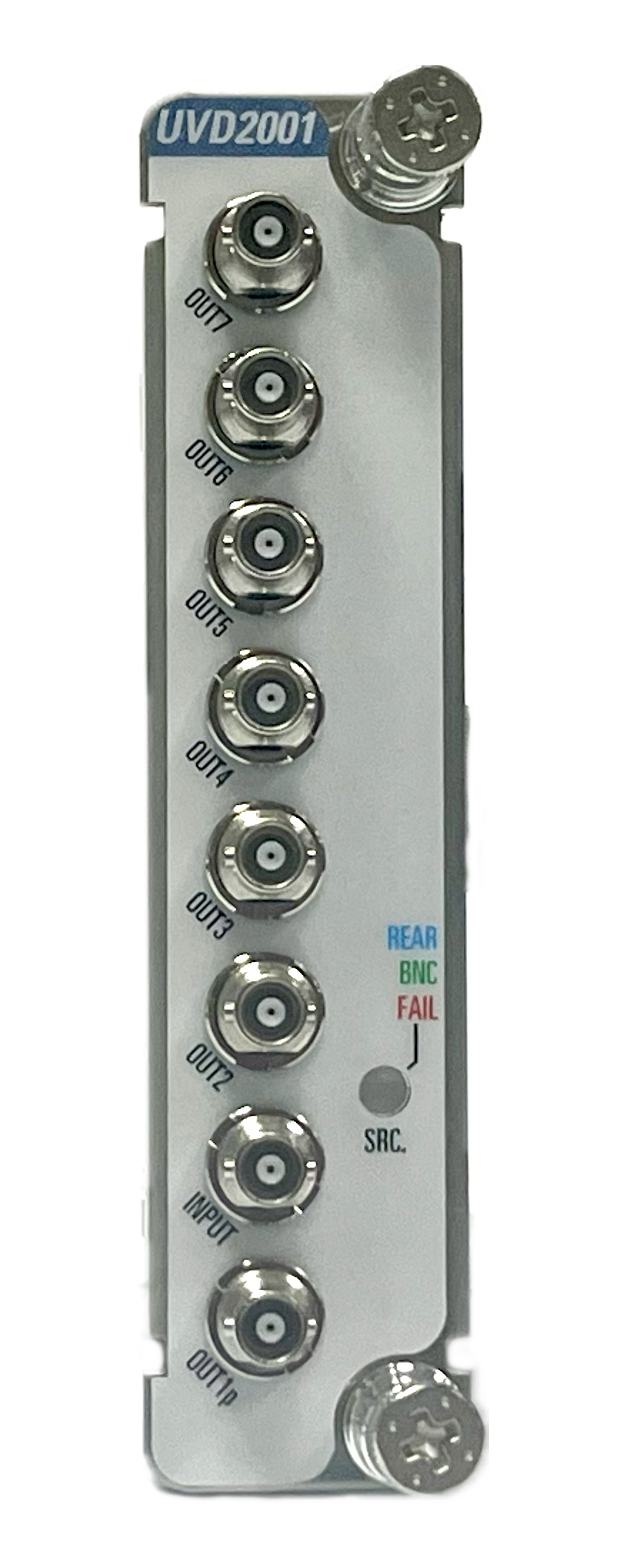
The UVD2001C01 front panel has been designed in accordance with the standard philosophy of Albalá Ingenieros TL2000 series modules: to provide all necessary signal-status information by means of LED indicators, while also offering straightforward access to all input and output connections.
The module name (UVD2001C01) appears at the top of the front panel.
The front panel contains 75 Ω HD-BNC connectors arranged, from top to bottom, as follows:
• Outputs 7 to 2 (OUT7..OUT2)
• Input (INPUT)
• Protected output (OUT1p)
All outputs deliver the signal regenerated by the reclocking circuit, except when the module loses power. Output OUT1P incorporates bypass protection and is therefore the recommended output whenever signal continuity must be maintained even during a fault or loss of power.
A diagnostic LED (SRC) is located at the lower right of the front panel. It provides an at-a-glance indication of the distribution amplifier's operating status:
• It lights green when the signal at the front-panel HD-BNC INPUT is valid.
• It lights red when the signal at the front-panel HD-BNC INPUT contains errors.
• It lights cyan when the remote-control interface has been used to enable transmission of the video signal via the chassis backplane to the adjacent module installed immediately to its right.
These indicators allow the operation of the distribution amplifier to be checked quickly during installation or maintenance.
Distribution amplifier for 12G/3G/HD/SD-SDI digital video signals
The bypass maintains the signal path from the input to the protected output for at least 1,000 hours after the power supply is disconnected
The signal received at the front-panel input can be sent via the backplane to the module installed immediately to its right
The input includes an equalizer capable of equalizing Belden 1694A up to:
• 45 metres at 12 Gbit/s.
• 100 metres at 3 Gbit/s.
• 100 metres at 1.5 Gbit/s.
• 450 metres at 270 Mbit/s.
Includes data-clock regeneration (reclocking)
The distribution amplifier does not manipulate the video information contained in the frame in any way, nor is it sensitive to the video payload being distributed
Remote control and monitoring available through a communications module installed in the same chassis
Low power consumption

 Albalá Ingenieros