The technological migration from DVB-T to DVB-T2 in broadcasting, aimed at enabling the transmission of Ultra High Definition 4K (UHD) signals over DTT, requires a new deployment of links and new redundancy management. In the event of any incident, seamless, error-free switching between redundant link signals must be ensured.
The basic reliability of the transmission system is based on 1+1 link redundancy.
For the operator, if one of the redundant links fails due to signal or packet loss, the most important requirement is that the transmitter does not shut down and that a clean, error-free switch to the other link takes place.
To meet this need, the IPA3000C02 automatic switch has been developed. This module also incorporates an additional protection mechanism for extreme cases in which only one link remains available and occasional packet losses occur, as may happen in IP transmissions. This ultra-reliability backup mechanism replaces lost packets with others that maintain frame continuity.
In the DVB-T transmission process, a procedure is activated to replace lost packets with null packets so that the packet counter remains consistent and the equipment does not shut down, since restarting the transmitter requires several seconds during which the screen would go black. With this solution, the transmitter remains operational and packet loss has a negligible impact on the image.
In the case of DVB-T2, replacing lost TS packets over IP with null packets does not prevent transmitter interruptions. To solve this, the IPA3000C02 incorporates a process that analyzes the structure of the delivered T2MI frame. If lost T2MI packets are detected, they are replaced with packets from the last valid T2MI superframe received, and certain fields are recalculated to ensure T2MI frame sequence continuity without affecting transmitter operation.
It is common for the TV signal TS to multiplex additional services. When broadcasting in DVB-T, this TS could be directly used as a source for decoders to extract those services. Now, in DVB-T2, since the TS is encapsulated in a different frame (T2MI), existing decoders cannot recognize it. To avoid replacing all such equipment and allow continued operation, the IPA3000C02 switch decapsulates the T2MI frame to recover the original Transport Stream, which can be correctly interpreted by existing decoders.
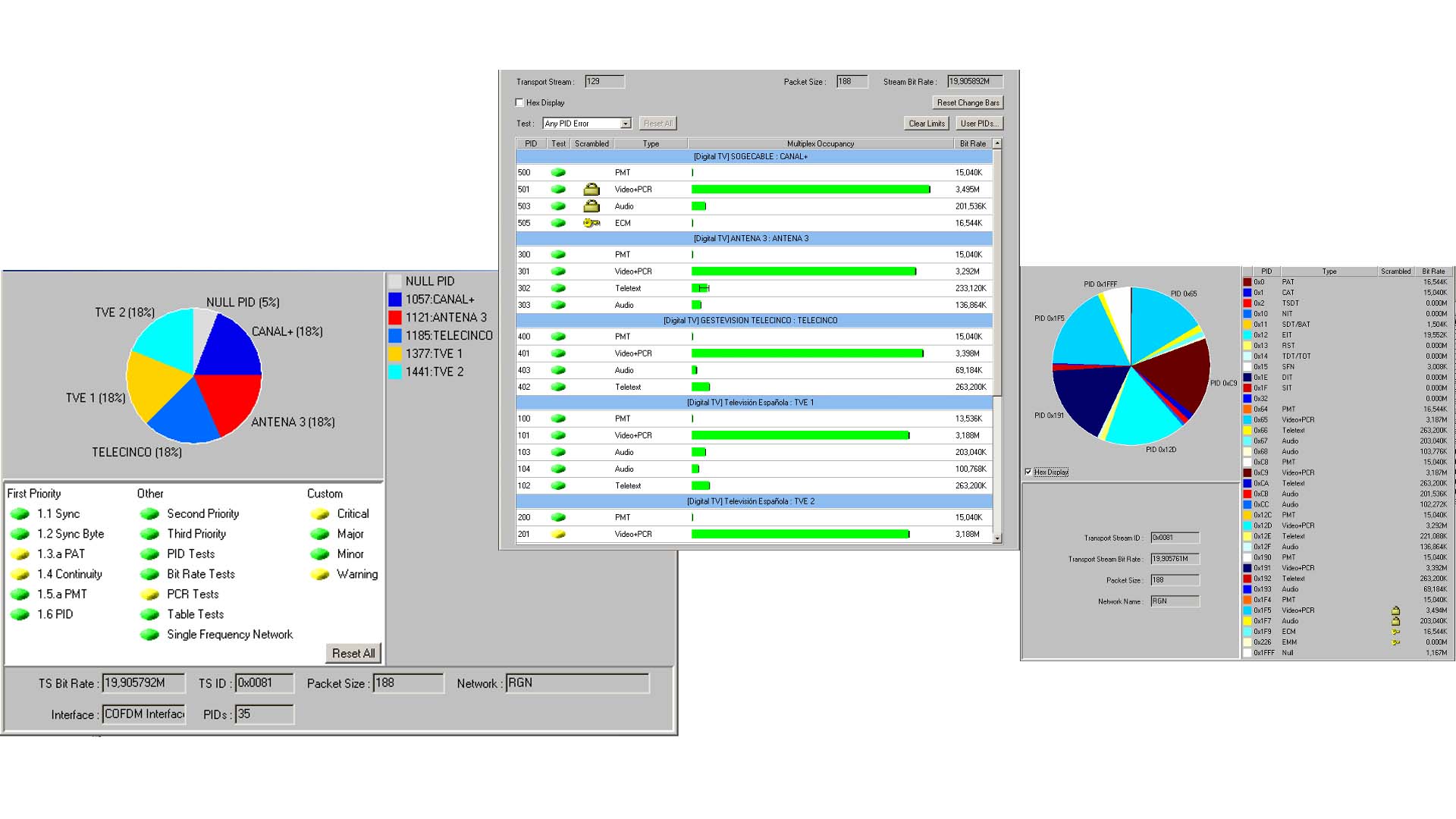
The IPA3000C02 module is an automatic DVB-ASI and DVB-over-IP frame switch that operates based on signal presence at its inputs, the status of various received frame parameters, and information provided through the GPI connector according to user-defined input priorities.
The equipment features two inputs, MAIN IN and RES IN, through which it receives two DVB-ASI frames: ASI MAIN (primary DVB-ASI) and ASI RES (backup DVB-ASI).
It also includes a 1 Gbit/s Ethernet interface through which it can receive two DVB-over-IP streams (UDP/RTP with and without FEC), referred to as IP MAIN (primary DVB over IP) and IP RES (backup DVB over IP). Any of the four input streams can be enabled or disabled. The currently selected input is distributed to four DVB-ASI outputs and can also be transmitted over IP via the Ethernet interface.
For DVB streams, the IPA3000C02 module can operate in three different modes:
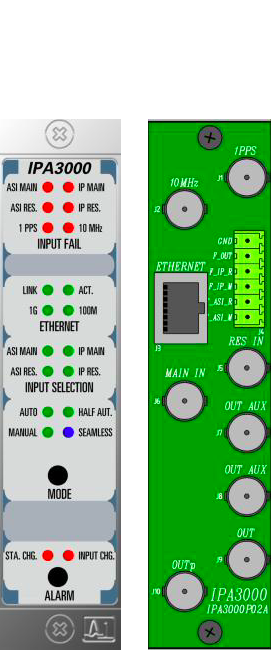
• Generic DVB ModeThe illustration shows the front and rear connection panels of the IPA3000C02 module.
The IPA3000C02 module includes two DVB-ASI inputs (MAIN IN, RES IN) and four DVB-ASI outputs (OUT AUX, OUT AUX, OUT, OUTp). It also features an Ethernet connection providing two DVB-IP inputs and one DVB-IP output.
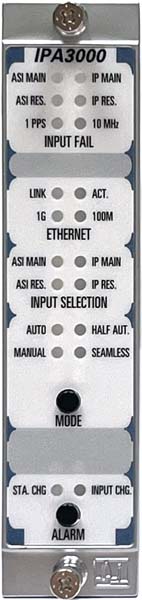
The front panel includes a set of status and alarm indicators.
The IPA3000C02 offers three switching modes:
• Automatic Mode
In this mode, the IPA3000C02 automatically selects the highest-priority input that is neither faulty nor disabled.
• Semi-Automatic Mode
This mode minimizes switching. The IPA3000C02 switches only if the currently selected input fails and at least one of the other three inputs is not in a fault state.
• Manual Mode
Manual mode is useful for maintenance tasks. The user selects the input signal, and no changes occur even if faults appear. The selected input is stored in non-volatile memory and restored in case of power failure.
When DVB frames are transported over ASI interfaces, the latency introduced by frame serialization and deserialization is very small compared to other signal transport delays.
When DVB frames are encapsulated in IP, mechanisms are required to correct errors and absorb jitter generated by IP networks. These mechanisms require higher IP network bandwidth and increase link latency.
Specific Functionalities in DVB-T2 Mode
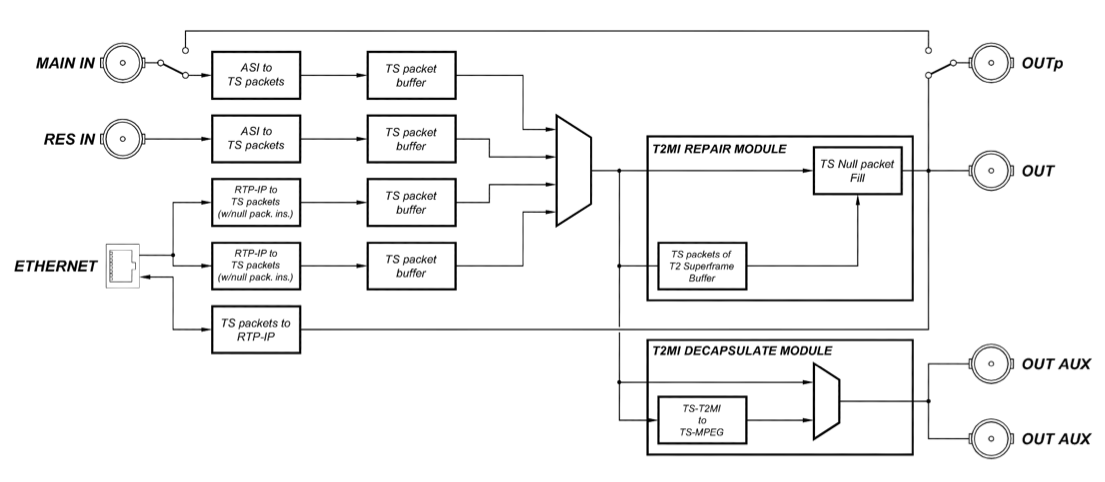
When operating in DVB-T2 mode, the IPA3000C02 enables three additional functions through the functional blocks shown in the following figure:
1 - T2MI Frame Repair by Inserting Null Packets
When Transport Stream (TS) flows are received over IP, packet loss may occur. In extreme cases where only one input signal is available, the effects of such losses can be corrected or mitigated in two ways:
• Using FEC mechanisms, at the expense of increased transmitted bitrate and latency
• If RTP is used, replacing lost TS packets with null packets
If the latter option is chosen, the delivered TS bitrate remains correct and, in DVB-T, prevents transmitters from shutting down, even though the content may be erroneous.
In DVB-T2, however, replacing lost TS packets with null packets does not prevent transmitter shutdown. To solve this, a method has been developed that analyzes the delivered T2MI frame structure. If lost T2MI packets are detected, they are replaced with packets from the last valid T2MI superframe received, and certain fields are recalculated to ensure T2MI frame sequence continuity.
2 - New Structural Seamless Operating Mode
This new operating mode is designed to switch between TS streams containing T2-MI frames generated using the mechanisms described in the DVB-SIS standard (ETSI TS 103 615). Frames generated in this manner are not bit-by-bit identical, making bit-level alignment impossible. Additionally, switching between them would cause transmitters to shut down because the switch would not be seamless.
To solve these issues, the IPA3000C02 includes a new functionality that compares and aligns received TS streams using only T2-MI packet headers. During switching, the T2-MI packet checksums are recalculated to avoid errors. Finally, the continuity counters (CC) of all MPEG TS packets encapsulating the T2-MI frame are updated.
3 - Decapsulation of the TS-MPEG Stream Contained in T2MI Packets
The decapsulation module allows recovery of the TS-MPEG stream transmitted within the Baseband (BB) frames of the TS-T2MI stream and sends it to the two ASI output connectors labeled OUT AUX.
Seamless automatic switch for DVB Transport Stream signals.
Four inputs: two DVB-ASI and two DVB over IP (UDP and RTP with and without FEC), allowing switching among all four sources.
Provides an output DVB Transport Stream distributed to four BNC connectors (DVB-ASI) and to the Ethernet interface (DVB over IP). One of the BNC DVB outputs is protected by bypass relays.
Selectable input channel fault criteria defined in the First Priority table of ETSI TR 101 290 V1.2.1, together with megaframe synchronization presence in DVB-T mode or superframe synchronization in DVB-T2 mode.
External fault indicators via GPI for each signal source.
Three operating modes: Automatic, Semi-Automatic, and Manual.
Tecnología de Bajo consumo.

 Albalá Ingenieros